Poetry prompts are little bits of inspiration… Either a line to spark a muse, a title, or a picture. Today I am giving you a line. Show me what you can do with it. Feel free to adjust the line to however your poem needs.
Poetry is emotions in written form. It is a pure form of expression unique to each person. It is technical and it is free flowing. Poetry is the world’s most complex and easy form of communication.
The Basics of Poetry I personally write free verse. I experiment with other types… But I am most comfortable with free verse. The thing with poetry is in writing it you can ignore the rules, poetic license is a thing… But you should know what the rules are before you break, or ignore, them.
1. Stanzas They are a series of lines grouped together. Its the poetry version of a paper’s paragraph.
2. Form Commonly the ruleset used for the poem. As I stated… I prefer free verse… But there is also
1.) Blank verse. Blank verse is poetry written with a precise meter—almost always iambic pentameter—that does not rhyme. 2.) Rhymed poetry. In contrast to blank verse, rhymed poems rhyme by definition, although their scheme varies. 3.) Epics. An epic poem is a lengthy, narrative work of poetry. These long poems typically detail extraordinary feats and adventures of characters from a distant past. 4.) Narrative poetry. Similar to an epic, a narrative poem tells a story. Henry Wadsworth Longfellow’s “The Midnight Ride of Paul Revere” and Samuel Taylor Coleridge’s “The Rime of the Ancient Mariner” exemplify this form. 5.) Haiku. A haiku is a three-line poetic form originating in Japan. The first line has five syllables, the second line has seven syllables, and the third line again has five syllables. 6.) Pastoral poetry. A pastoral poem is one that concerns the natural world, rural life, and landscapes. These poems have persevered from Ancient Greece (in the poetry of Hesiod) to Ancient Rome (Virgil) to the present day (Gary Snyder). 7.) Sonnet. A sonnet is a 14 line poem, typically (but not exclusively) concerning the topic of love. Sonnets contain internal rhymes within their 14 lines; the exact rhyme scheme depends on the style of a sonnet. 8.) Elegies. An elegy is a poem that reflects upon death or loss. Traditionally, it contains themes of mourning, loss, and reflection. However, it can also explore themes of redemption and consolation. 9.) Ode. Much like an elegy, an ode is a tribute to its subject, although the subject need not be dead—or even sentient, as in John Keats’ “Ode on a Grecian Urn”. 10.) Limerick. A limerick is a five-line poem that consists of a single stanza, an AABBA rhyme scheme, and whose subject is a short, pithy tale or description. 11.) Lyric poetry. Lyric poetry refers to the broad category of poetry that concerns feelings and emotion. This distinguishes it from two other poetic categories: epic and dramatic. 12.) Ballad. A ballad (or ballade) is a form of narrative verse that can be either poetic or musical. It typically follows a pattern of rhymed quatrains. From John Keats to Samuel Taylor Coleridge to Bob Dylan, it represents a melodious form of storytelling. 13.) Soliloquy. A soliloquy is a monologue in which a character speaks to him or herself, expressing inner thoughts that an audience might not otherwise know. Soliloquies are not definitionally poems, although they often can be—most famously in the plays of William Shakespeare. 14.) Villanelle. A nineteen-line poem consisting of five tercets and a quatrain, with a highly specified internal rhyme scheme. Originally a variation on a pastoral, the villanelle has evolved to describe obsessions and other intense subject matters, as exemplified by Dylan Thomas, author of villanelles like “Do Not Go Gentle Into That Good Night.”
3. Sound Patterns Rhyme is the repetition of similar sounds. In poetry, the most common kind of rhyme is the end rhyme, which occurs at the end of two or more lines. It is usually identified with lower case letters, and a new letter is used to identify each new end sound. Internal rhyme occurs in the middle of a line.
4. Figurative Devices Simile is the rhetorical term used to designate the most elementary form of resemblances. Most similes are introduced by “like” or “as.” A metaphor leaves out “like” or “as” and implies a direct comparison between objects or situations. “All flesh is grass.” A symbol is like a simile or metaphor with the first term left out. “My love is like a red, red rose” is a simile. If, through persistent identification of the rose with the beloved woman, we may come to associate the rose with her and her particular virtues. At this point, the rose would become a symbol. Personification occurs when you treat abstractions or inanimate objects as human, that is, giving them human attributes, powers, or feelings (e.g., “nature wept” or “the wind whispered many truths to me”).
Note that poetry is possible without rhyme, or simile or metaphor. As I said… Learn how to write with the rules and then adapt poetry to suit you. Don’t let your poetry suffer for someone else’s views on what poetry should be.
I have planned to do a poetry based post every day of April… To celebrate national poetry month… And then chaos… You know… My life…. Happened. My allergies are still kicking my butt. Yesterday I was down with a tension headache. I am going to be doing a post later today… But I didn’t want to start off a day late with no introduction of my intent.
I do not know if I will be doing the normal posting schedule with this new posting. There is going to be 4 types of post for the national poetry month. 1. prompts (this is fairly self explanatory) 2. Poetry(mine or a famous poet) 3. Lesson (I with these are planning on trying to show how to write poetry… Or types of poetry) 4. Submissions (I will be sharing places looking for poems)… I am not sure what is going to be what day… But I am going to be trying to post daily. May will see a return to the normal schedule.
Also, Fae Corps is going to do a daily prompt starting later today. (I am the one usually doing the blog there so my headache yesterday prevented the normal Indie Wednesday post. I had forgotten to schedule it)
Ok. April is likely to be a very busy time. National poetry month usually sees me posting poetry posts on here daily as I do the P. A. D. Challenge. I also plan on doing a daily prompt for the Fae corps Blog. It is also going to be when we are starting a call for submissions on two different anthologies. Fae Dreams… Poetry, art, and short stories with a theme of goals, plans, and dreams. (We recieved one too many submissions for Through the Sunshine and offered a guaranteed spot in this to the author). And Nightmare Whispers, a group of horror stories. This one is a tribute to where we started.
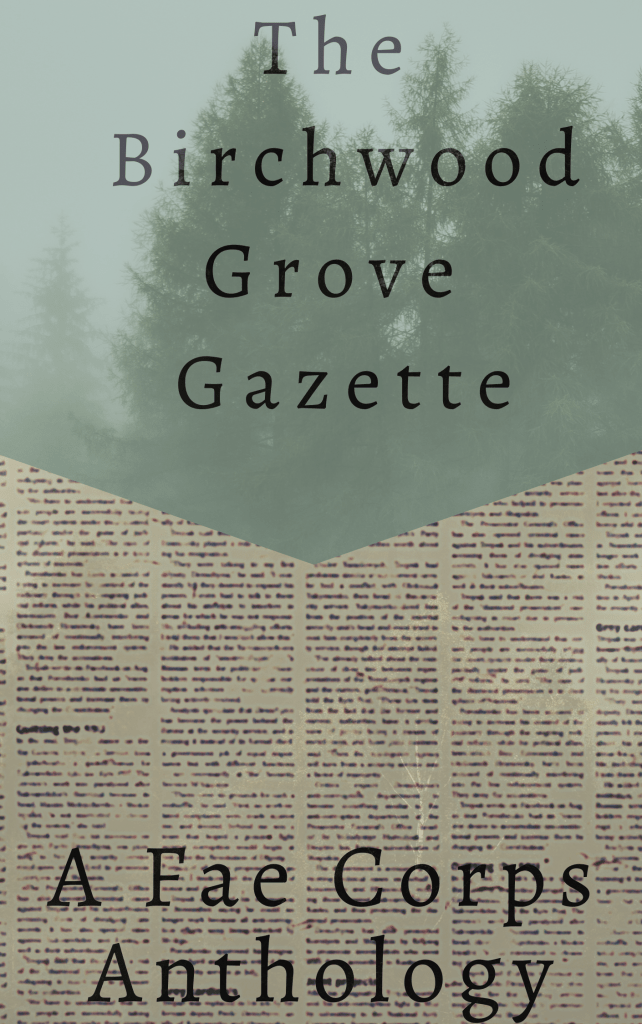
I am working on editing the stories submitted for Through the Sunshine, and compilation of Birchwood Grove Gazette. We are doing the basic edits… Then we give the author time to do their own edits. After we recieve the polished story we finalize the formatting of the final anthology. We have to get it all ready by the middle of May for release in June.
My partner and I discussed delaying Fae Dreams. We may still. I have to see how things go. I don’t know yet how ambitious we are going to be. We have ideas for a thriller themed anthology as well, though the title and cover have not been forthcoming from our muses so far.
I am proud to claim that the above covers are my creations. I think that I am really getting better at this. Keep an eye on the Fae Corps Blog, as that is where any official announcement will be. This is mostly me doing mental meandering.
The editors on coffee house writers challenged the poetry department to write a sestina. That is so out of my wheelhouse, so I am very proud of the result. So proud that I used it for my post this time.






 Pattimouse